
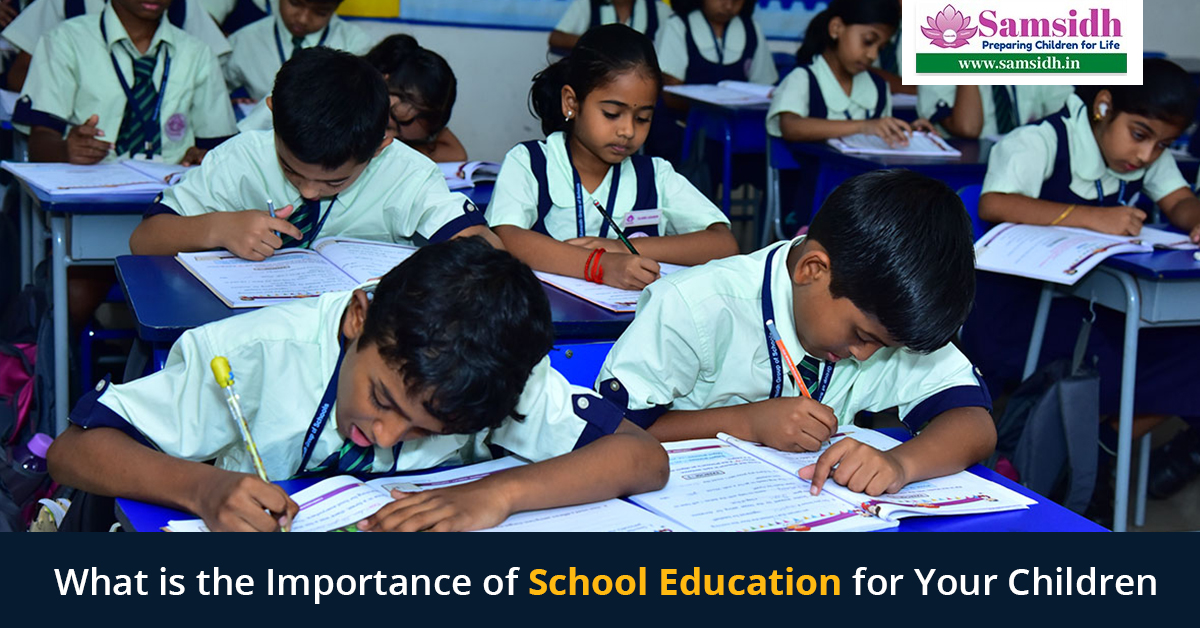
Why is the importance of school education significant for children? School education is important for children because it provides the structured environment, social experiences, and guided learning that no home setting alone can fully replicate. Beyond academics, school shapes a child’s character, communication skills, emotional intelligence, social abilities, work ethic, and sense of identity. It teaches children how to learn, how to navigate relationships, how to handle setbacks, and how to think independently. In other words, school doesn’t just prepare children for exams — it prepares them for life. The right school becomes the foundation on which a child’s entire future is built.
Children spend about 14 years of their lives in the school environment. In these formative years of their life, they learn the concepts of most subjects. However, the end-goal of a school isn’t just to give students a certificate to enter higher education. The real purpose of a school goes far beyond academic education it helps in nurturing the personality in children and shaping them into adults who add value to the society.
Read more : WOOP Method for Goal Setting in Kids
1. Impact of NEP 2020 Reforms on Children’s Education in 2025
The National Education Policy (NEP 2020) has started reshaping school education in 2025. The policy emphasizes foundational literacy and numeracy, activity-based learning, and holistic skill development. For children, this means a stronger focus on critical thinking, creativity, and problem-solving skills, rather than rote memorization. Parents today are seeing how CBSE schools adopting NEP reforms are preparing children not just for exams but for lifelong learning.
2. How AI and Digital Tools are Shaping School Learning
In 2025, the role of technology in schools has expanded rapidly. With AI-powered learning apps, interactive digital classrooms, and personalized assessments, children can now learn at their own pace. For example, adaptive AI platforms suggest practice exercises based on a child’s strengths and weaknesses. This not only improves academic performance but also keeps children engaged and motivated.
3. Balancing Academics with Life Skills
Education today is not just about academic grades. Schools are focusing equally on life skills such as time management, empathy, teamwork, and emotional intelligence. These skills help children face challenges with confidence and prepare them for leadership roles in the future. CBSE schools, especially those integrating value-based education, are showing how a balanced approach creates well-rounded individuals.
What School Education Teaches Children Beyond the Syllabus
Most parents think school education = academics. The truth is that the vast majority of what makes a child successful in life comes from things schools teach incidentally — through daily interactions, structure, and shared experiences. Here’s a side-by-side look at what’s in the curriculum versus what children actually learn at school:
| Visible Curriculum (What’s Taught) | Hidden Curriculum (What’s Actually Learned) |
|---|---|
| Mathematics, Science, Languages | How to learn, persevere, and solve problems independently |
| Social Studies and History | Identity, civic awareness, cultural empathy, world-view formation |
| Physical Education and Sports | Teamwork, discipline, resilience, handling defeat, fair play |
| Arts and Crafts | Creativity, self-expression, patience, attention to detail |
| Group Projects and Assignments | Collaboration, leadership, conflict resolution, accountability |
| Daily Schedule and Timetables | Time management, self-discipline, work-life rhythm |
| School Rules and Norms | Ethics, integrity, social responsibility, respect for systems |
| Classroom Discussions and Q&A | Confidence, public speaking, critical thinking, expressing ideas |
| Friendships with Classmates | Emotional intelligence, empathy, social navigation, handling rejection |
| Tests, Exams, and Assessments | Performing under pressure, managing stress, self-evaluation |
This is why school education matters far more than academics alone could ever measure. The right school environment shapes the person your child becomes — not just the marks they score.
Let us look at some core reasons why school education is essential for your child.
Gaining Knowledge
As an educational institution, the school provides a conducive atmosphere to the students to learn from a teacher. An age appropriate syllabus is assigned to the children till they graduate from school and the students learn more complicated concepts in the higher field of education. With a systematic evaluation process, students learn to improve their skills, compete in a healthy manner, and thrive in a constructive atmosphere. The schools with the best academics teach fundamental subjects like languages, mathematics, science, social science, etc., preparing them for higher studies, specialisations, and eventually for an employment of their choice and capacity.
Building Social Skills
When children enrol in a school, they are exposed to other children of similar age, from all walks of life and this helps them to learn to cooperate, negotiate and navigate in such an atmosphere. Students acquire interpersonal skills and communication skills resulting in the expansion of their social circle. Through group activities like sports, they learn teamwork and leadership skills. They are also exposed to the diversity of our culture in such an environment.
School Education in 2025: A Modern Perspective
The role of school education in shaping a child’s future has expanded significantly in 2025. With the NEP 2020 reforms, skill-based learning and digital literacy are now core components of the curriculum.
-
Skill-Based Curriculum: Schools now focus on problem-solving, communication, and critical thinking alongside academic subjects.
-
AI Integration in Classrooms: AI tools help personalize learning, identify student strengths, and provide targeted practice.
-
Holistic Development: Equal emphasis is placed on academics, sports, arts, and emotional well-being to nurture well-rounded individuals.
Case Study – Before & After Strong Schooling
Riya, a Grade 4 student, initially struggled with low confidence and academic performance. After joining a school with skill-based learning, she improved in communication, problem-solving, and team activities — ultimately excelling academically and socially.
Learning Discipline
A school has a definite set of rules. Students are exposed to the nuances adjusting in a society by being in such an environment. The school instils in them the quality of discipline, one of the most critical life skills which leads them to evolve as better human beings and succeed in life.
Extracurricular Activities
The school allows students to identify and explore their talents and find where their natural inclinations lie. Students take up music, sports, dance, art, theatre, writing, etc., as extracurricular activities and thrive in areas other than in academics.
Encouraging learning
Learning is a lifelong activity that begins the moment we are born. The school being the main platform for learning different subjects, not only imparts education but also equips the children with various learning techniques. For example, the math classes expose the student to the fundamentals of mathematics while honing their problem-solving skills, deductive skills, etc.
Building Networks
The life within the walls naturally expands to the outside world as well. Students make friendships that continue into their adult lives. These are relationships that stay with them for a long time. They also connect to their teachers and other students outside of their classroom. This way, school becomes the ground for developing a social life for the students.
Summing Up
School education is the most crucial aspect of a child’s formative years. A child’s overall development is affected by the school the parents choose for him/her. It is vital that, as a parent, you pick a school with the best academics and extracurricular activities. Samsidh group of schools is among the schools with the best academics in India. We instil in our students the skills of curiosity, creativity, initiative, interdisciplinary thinking, gratitude, and empathy to transform them into compassionate, humble, and happy individuals with the potential to become tomorrow’s leaders.
Looking for a CBSE school that develops your child beyond academics?
At Samsidh Group of Schools, we believe education must shape character, confidence, and capability — not just exam marks.
Our CBSE campuses across Bangalore including
HSR Layout,
Electronic City,
Horamavu, and Vidyaranyapura integrate academics with values, sports, arts, and life skills.
Schedule a campus visit
to see our approach to whole-child education.
Frequently Asked Questions: Importance of School Education for Children
1. Why is school education important for children?
School education is important because it does what home schooling alone cannot fully replicate — providing structured learning, social experiences with peers, exposure to diverse viewpoints, and consistent guidance from trained educators. School shapes a child’s character, communication skills, emotional intelligence, work ethic, and sense of identity. It prepares them not just for exams, but for life.
2. What are the benefits of school education for a child?
The benefits of school education include: academic knowledge and concept-based learning, development of social and communication skills, exposure to diverse cultures and viewpoints, building emotional intelligence and resilience, learning teamwork and leadership, developing time management and discipline, and discovering personal strengths and interests through varied activities. These benefits compound over a lifetime.
3. Is school education better than home schooling?
For most children, school education offers benefits that home schooling cannot easily provide — daily peer interaction, exposure to diverse viewpoints, structured social experiences, access to trained educators, and a community that builds belonging. Home schooling can be a valid choice for specific situations, but the social and emotional benefits of school environments are difficult to fully replicate at home.
4. How does school education shape a child’s character?
School shapes character through daily exposure to rules, expectations, social norms, peer interactions, and mentorship. Children learn integrity by being held accountable, empathy by working in groups, resilience by failing and trying again, and values like fairness, honesty, and respect through their teachers’ conduct. Character isn’t taught in one lesson — it’s built across years of school experiences.
5. What is the role of school in a child’s development?
Schools play a foundational role in cognitive, social, emotional, and physical development. Cognitively, they build literacy, numeracy, and critical thinking. Socially, they teach children to form relationships and work with others. Emotionally, they help children manage feelings and handle setbacks. Physically, sports and activities develop coordination and health. Together, schools nurture the whole child.
6. At what age should a child start formal school education?
Most children in India start formal school education between ages 3-4 (Pre-K) and ages 5-6 (Grade 1). The right starting age depends on the child’s emotional readiness, social skills, attention span, and family circumstances. Look for signs of school readiness: the ability to follow simple instructions, separate from parents calmly, manage basic self-care, and show curiosity about learning.
7. What makes a good school education?
A good school education balances academic rigour with character development, individualised attention with group learning, and structured discipline with creative freedom. Look for: qualified and caring teachers, a well-designed curriculum (like CBSE’s NCERT framework), strong values education, diverse co-curricular activities, manageable class sizes, transparent parent communication, and a track record of student outcomes — both academic and personal.
8. How can parents support their child’s school education?
Parents support school education most effectively by: maintaining open communication with teachers, creating a positive learning environment at home, reinforcing school values, attending parent-teacher meetings, helping with homework without doing it for the child, celebrating progress (not just marks), reading together, and modelling the curiosity and discipline they want to see in their child.