
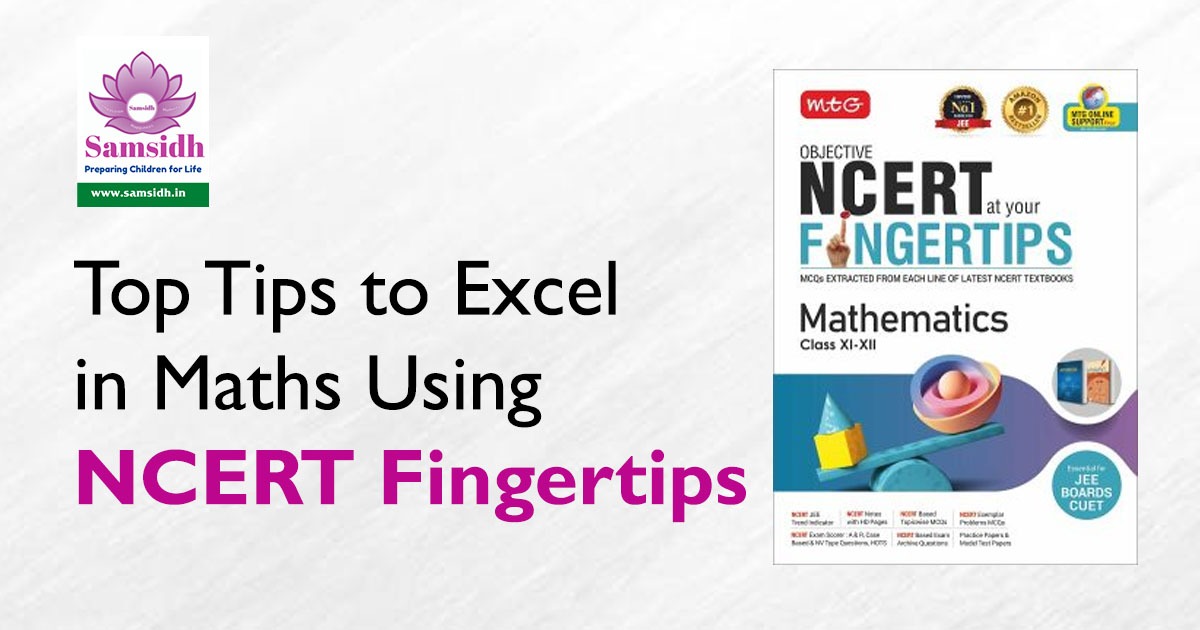
NCERT Fingertips is a CBSE-aligned MCQ + case-based practice book. Use it by: (1) finishing the NCERT chapter first, (2) solving Fingertips MCQs sub-topic by sub-topic, (3) reviewing every wrong answer, and (4) attempting assertion-reason questions in your final 4 weeks. Students who follow this method consistently score 85–95 in CBSE Class 10 Maths.
| ✅ NCERT Fingertips is the most CBSE-aligned practice resource — it covers every chapter in the exact question formats used in board exams.
✅ Always finish the NCERT textbook chapter before opening Fingertips. ✅ Solve sub-topic by sub-topic. Review every wrong answer. Maintain an error notebook. ✅ Case-based and assertion-reason questions in Fingertips mirror the CBSE board format directly. ✅ Do each chapter at least twice — once in study phase, once timed in revision phase. ✅ Follow the 60-day plan: complete → eliminate weaknesses → mock → light review. |
Mathematics is one of the most scoring subjects in CBSE Class 10 — but only when students practise in the right format. With 40% of the board paper now consisting of MCQs and case-based questions, simply solving NCERT exercises is not enough.
That is exactly where NCERT Fingertips becomes your most strategic tool. This guide walks you step by step through how to use it for maximum results in CBSE 2025.
What Is NCERT Fingertips?
NCERT Fingertips is a curriculum-aligned practice book published by MTG Learning Media that covers every chapter of the NCERT Class 10 Maths textbook. It includes:
- Multiple Choice Questions (MCQs) — mapped to each NCERT sub-topic
- Assertion-Reason type questions — testing conceptual clarity
- Case-based questions — introduced for CBSE 2024–25 paper pattern
- Previous years’ CBSE board questions — chapter-mapped for context
- Fill-in-the-blank exercises — reinforcing formula recall
Why CBSE Students Must Use It in 2025
The CBSE board exam pattern changed significantly from 2023–24 onwards. Here is the current Class 10 Maths structure:
| Question Type | Marks | Paper Share | Fingertips Helps? |
| Section A — MCQs | 1 mark each | 40% | ✅ Directly |
| Section B & C — Short Answer | 2–3 marks | 35% | ✅ Partially |
| Section D & E — Case-Based / Long | 4–5 marks | 25% | ✅ Case Qs |
MCQs now carry 40% of the paper. Students who only practise NCERT exercises are training in the right content but the wrong format for nearly half the paper.
Want to understand how CBSE’s curriculum prepares students for competitive exams beyond boards?
Read more: Why CBSE Curriculum Is Ideal for Competitive Exam Preparation
Step-by-Step: How to Use NCERT Fingertips
Follow this exact sequence for every chapter. Skipping steps reduces the method’s effectiveness significantly.
Chapter-Wise Priority Strategy
Not all chapters carry equal marks. Allocate your Fingertips practice time proportionally.
High Priority Chapters — Focus 60% of Your Time Here
- Chapter 3 — Pair of Linear Equations: High-weightage; master all four solution methods before moving on
- Chapter 5 — Arithmetic Progressions: Consistent 8–10 marks; Fingertips covers nth term and sum formulae in depth
- Chapter 10 — Circles: Tangent and chord theorems appear every year; solve all assertion-reason questions
- Chapter 13 — Statistics: Case-based questions in Fingertips mirror the board format almost exactly
Medium Priority Chapters — 30% of Your Time
- Chapter 6 — Triangles: Lengthy but scoring; drill AA, SSS, SAS criteria until instinctive
- Chapter 8 — Trigonometry: Test yourself daily with Fingertips MCQs until all standard angle values are instant recall
- Chapter 12 — Areas Related to Circles: Formulae-heavy; Fingertips catches the most common unit-substitution errors
Lower Weight Chapters — 10% of Your Time
- Chapters 1, 2, 9, 11, 14, 15 — do not neglect, but keep Fingertips practice to one round only
Taking maths further? See how Samsidh students prepare for competitions: Junior Math Olympiad 2025 — Tips to Win with Confidence
Common Mistakes to Avoid
Students who do not improve despite using NCERT Fingertips usually make one of these five errors:
Mistake 1 — Using Fingertips Before the Textbook
Fingertips tests application. Without the NCERT concept first, you are guessing — and guessing builds wrong habits.
Mistake 2 — Skipping Explanations for Correct Answers
Even correct answers may be reached through wrong logic. Always read the explanation to confirm your method.
Mistake 3 — Treating All Chapters Equally
Chapter 3 carries 3–4x more marks than Chapter 14 in some years. Allocate Fingertips time by chapter weight.
Mistake 4 — Doing Fingertips Only Once
The best students do each chapter at least twice: once in the study phase and once timed in the revision phase.
Mistake 5 — Ignoring Case-Based Questions
CBSE’s mandatory 8-mark case-based section is fully covered in Fingertips. Skipping it is leaving guaranteed marks behind.
60-Day Revision Plan
Integrate NCERT Fingertips into your final revision using this structured schedule:
| Days 1–30: Chapter Completion Phase
Target: 1 chapter per day (or 2 lighter chapters per day) • Morning: Re-read NCERT concept notes • Afternoon: Solve Fingertips MCQs for that chapter • Evening: Review wrong answers, update error notebook Days 31–45: Weak Area Elimination Phase • Revisit your error notebook • Re-solve all Fingertips questions you got wrong in Days 1–30 • Focus 80% of this phase on your bottom 3 chapters by accuracy Days 46–55: Full-Length Mock Phase • Attempt 2 full CBSE sample papers per week (timed, exam conditions) • After each mock: cross-check every wrong MCQ answer with Fingertips explanations • Target: 90%+ in MCQ section before Day 55 Days 56–60: Light Revision Only • Only re-read your error notebook — no new practice • Focus on sleep, nutrition, and confidence |
For a holistic approach beyond academics, explore: Top 7 Life Skills Every CBSE Student Must Master in 2025
How Samsidh Students Use NCERT Fingertips
At Samsidh Group of Schools, NCERT Fingertips is integrated into the school year — not just reserved for exam preparation:
- Monthly chapter tests are modelled on the Fingertips MCQ format from July onwards, so students are comfortable with the question style well before boards
- Teachers identify the 3 most common error patterns from Fingertips data and address them in dedicated remedial sessions
- Case-based questions from Fingertips are used in class as group problem-solving exercises to build collaborative reasoning
- Students track their chapter-wise accuracy across three Fingertips attempts throughout the academic year
Samsidh’s classroom also leverages technology for personalised learning.
Learn more: How Technology Is Changing the Face of Education
Curious about project-based learning and how it complements board prep?
Read more: CBSE Excellence: Learning Outcomes of Project-Based Education
Frequently Asked Questions
1. What is NCERT Fingertips for Maths and is it useful for Class 10?
Yes, NCERT Fingertips is extremely useful for Class 10 CBSE Maths. It covers every NCERT chapter through MCQs, assertion-reason questions, and case-based problems — all formats used in the CBSE board exam. Students who practise NCERT Fingertips alongside the textbook consistently score higher in the objective section of the board paper.
2. Is NCERT Fingertips enough for scoring 90+ in Class 10 Maths?
NCERT Fingertips, combined with complete NCERT textbook practice and 3–4 full-length CBSE sample paper attempts, is sufficient for scoring 90+ in Class 10 Maths. Additionally, practising previous years’ CBSE question papers from cbseacademic.nic.in gives students the strongest possible preparation.
3. Should I use NCERT Fingertips or RD Sharma for Class 10 Maths?
Use both for different purposes. NCERT Fingertips is ideal for board exam preparation because it matches CBSE’s question format (MCQ and case-based). RD Sharma is better for deep problem-solving skills for competitive exams. If you have time for only one, choose NCERT Fingertips for boards.
4. How many questions does NCERT Fingertips Class 10 Maths have?
NCERT Fingertips Class 10 Maths contains approximately 1,500 to 1,800 questions across all 15 chapters. This includes MCQs, assertion-reason pairs, fill-in-the-blanks, and case-based questions. Each chapter has 80–150 questions depending on its CBSE weightage.
5. How should I divide time between NCERT textbook and NCERT Fingertips?
Spend 60% of your chapter study time on the NCERT textbook and 40% on NCERT Fingertips practice. In the final 30 days before boards, reverse this: 30% on textbook notes and 70% on timed Fingertips practice and mock tests.
6. Which Class 10 Maths chapters have the most Fingertips questions?
Chapters with the most content are: Real Numbers, Polynomials, Pair of Linear Equations, Quadratic Equations, Arithmetic Progressions, Triangles, and Statistics. These chapters also carry the highest marks in the CBSE board paper.
7. Can NCERT Fingertips be used for Class 12 Maths as well?
Yes. NCERT Fingertips is available for Class 12 Maths and covers Calculus, Matrices, and Probability chapters in depth — all heavily MCQ-tested in recent CBSE patterns. The same step-by-step approach applies.