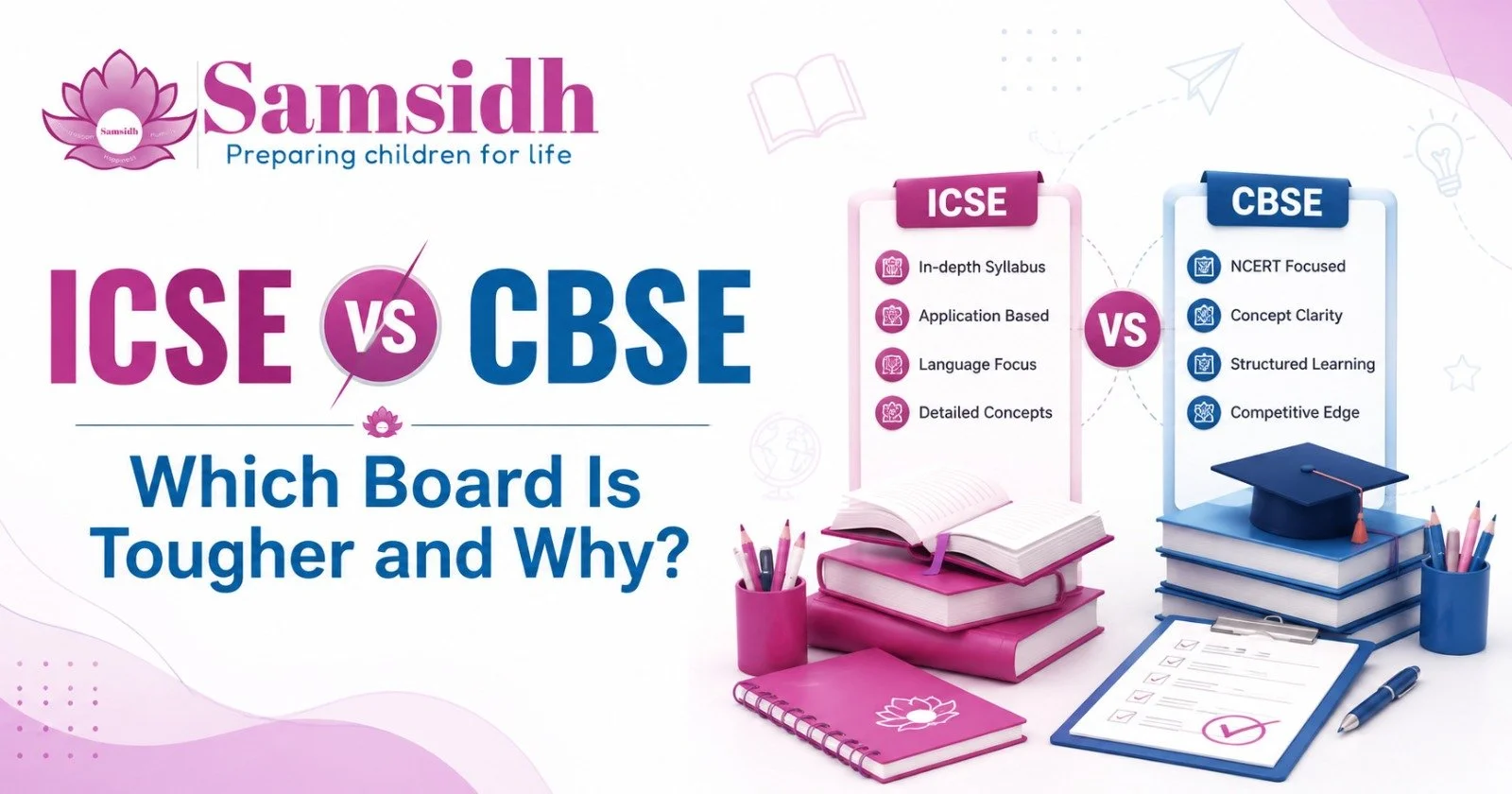
Neither board is universally “tougher” they are hard in different ways. ICSE (conducted by CISCE) is more demanding in syllabus breadth and descriptive writing, with heavier internal assessment and a strong English focus. CBSE (a Government of India board following NCERT) is more demanding in pace, precision and competitive-exam pressure, since it aligns closely with JEE and NEET. The right choice depends on your child’s learning style and, more than the board itself, on the quality of the school.
“CBSE or ICSE?” is one of the first questions parents face at admission time and it’s usually framed as which board is tougher? It’s the right instinct but the wrong finish line. Difficulty isn’t a single number; it shows up differently in each board, and the same child can find one “harder” than the other depending on how they learn. This guide breaks down the real CBSE vs ICSE differences syllabus, marking, difficulty, and career fit with a clear verdict, a comparison table and a simple way to decide.
CBSE vs ICSE
If you want a one-line verdict: ICSE feels tougher in content depth and writing, while CBSE feels tougher in pace and exam competitiveness. ICSE asks students to read widely and write detailed, well-structured answers across many subjects. CBSE asks students to master core concepts precisely and apply them at speed, in a format that mirrors national entrance exams. Both build strong students; they just stress different muscles.
What is CBSE? What is ICSE?
CBSE (Central Board of Secondary Education) is a national board managed by the Government of India. It follows the NCERT curriculum, has the largest school network in the country (including Kendriya Vidyalayas and many private schools), and is known for a concise, concept-focused syllabus that is strongly aligned with competitive entrance exams like JEE and NEET.
ICSE (Indian Certificate of Secondary Education) is the Class 10 examination conducted by CISCE (the Council for the Indian School Certificate Examinations), a private, non-governmental board. ICSE is known for a broad, detail-rich syllabus, a strong emphasis on English and languages, and significant project work and internal assessment. Its Class 12 equivalent is the ISC examination.
Understanding this core difference one government-run, standardised and exam-aligned; the other privately administered and content-dense explains almost everything else in the comparison.
CBSE vs ICSE
| Factor | CBSE | ICSE (CISCE) |
|---|---|---|
| Governing body | Government of India (CBSE) | CISCE (private/non-govt) |
| Curriculum | NCERT; concise, concept-focused | Broad, detailed, in-depth |
| Core strengths | Maths & Science; application | English, languages, humanities, all-round depth |
| Assessment style | Objective + competency-based; step-wise marking (partial credit for method) | Descriptive answers; heavier internal assessment & projects |
| Difficulty character | Pace, precision, exam pressure | Breadth, depth, writing load |
| Competitive-exam fit (JEE/NEET) | Strong, syllabus-aligned | Solid, but less directly aligned |
| English & communication | Good | Especially strong |
| School availability | Largest network across India | Fewer schools, mostly urban/private |
| Portability (transfers) | High — standardised nationwide | Lower — fewer schools to move between |
| Typical fees | Generally more affordable | Often higher |
| Best-fit learner | Structured, exam-focused, science/maths-inclined | Reader–writer, language-loving, detail-oriented |
So which board is actually tougher and why?
it depends on the child, not the board.
- ICSE is tougher for students who dislike lengthy theory and descriptive writing. Its wider syllabus and emphasis on well-framed, detailed answers — especially in English, History and Geography reward depth of expression and consistent effort.
- CBSE is tougher for students who struggle with speed, precision and application-based problem-solving. Its lighter reading load is offset by conceptual rigour in Maths and Science and the pressure of aligning with high-stakes national exams.
ICSE rewards depth; CBSE rewards precision. A strong reader writer may find CBSE’s pace stressful; a sharp problem-solver may find ICSE’s writing load tedious. “Tougher” is really a question of fit.
Which board suits which child?
Use this quick matrix to match your child’s style to a board:
| If your child… | Leans toward |
|---|---|
| Loves reading, writing and languages | ICSE |
| Prefers structure, clear concepts and objective tests | CBSE |
| Is aiming for JEE, NEET or Indian universities | CBSE |
| Enjoys projects, humanities and detailed study | ICSE |
| May transfer cities/schools often | CBSE (national portability) |
| Wants an affordable, widely available option | CBSE |
For many Indian families, CBSE’s structure, affordability and exam alignment tip the balance which is part of why CBSE is often preferred over the state board too.
CBSE vs ICSE for JEE, NEET and studying abroad
For competitive exams, CBSE has a practical edge: its syllabus is closely aligned with JEE (engineering) and NEET (medical), so CBSE students often find entrance-exam preparation more continuous with their school work. ICSE builds a strong, broad foundation and excellent English — valuable for a wide range of careers and for students who later move toward international pathways.
For studying abroad, both boards are recognised by universities in India and overseas. A common myth is that only international boards open doors abroad — in reality, CBSE and ICSE students regularly gain admission to foreign universities, especially with strong grades, entrance scores and a well-rounded profile.
The bigger factor: the school matters more than the board
Here’s what experienced educators will tell you: the board sets the syllabus, but the school decides the experience. A well-run CBSE school can feel vibrant, applied and future-ready; a weak school can make any board feel mechanical. The same board delivers very different outcomes depending on teaching quality, facilities, individual attention and co-curricular depth.
So before fixating on CBSE vs ICSE, evaluate the school just as carefully — its teachers, results, values and holistic-development record. Our guide on how to make the right choice while selecting a CBSE school walks through exactly what to look for.
How to choose the right board for your child (5 steps)
- Assess your child’s learning style – reader–writer or structured problem-solver?
- Define the goal – JEE/NEET and Indian universities (favours CBSE) or broad, language-rich study (favours ICSE)?
- Factor in mobility – will you relocate? CBSE’s national network makes transfers smoother.
- Weigh availability and budget – CBSE schools are more numerous and generally more affordable.
- Judge the school itself – visit, meet teachers, and prioritise teaching quality and holistic development over the board label.
Frequently asked questions
1. Is ICSE tougher than CBSE?
ICSE is often considered tougher in syllabus breadth and descriptive writing, while CBSE is tougher in pace and competitive-exam pressure. Which feels harder depends on the child’s learning style.
2.What is the main difference between CBSE and ICSE?
CBSE is a government board with a concise, exam-aligned NCERT curriculum. ICSE, conducted by CISCE, has a broader, more detailed syllabus with a strong focus on English and internal assessment.
3. Which board is better for JEE and NEET?
CBSE has an edge because its syllabus aligns closely with JEE and NEET, making entrance-exam preparation more continuous with school work.
4. Is CBSE or ICSE better for studying abroad?
Both are recognised internationally. Foreign universities accept CBSE and ICSE students; strong grades, entrance scores and a well-rounded profile matter more than the board.
5. Can a student switch from ICSE to CBSE?
Yes. Switching is possible, though it’s smoother at earlier grades; CBSE’s national network makes transfers between cities easier.
6. Which board has a tougher syllabus?
ICSE generally has the broader, more detailed syllabus; CBSE keeps a tighter focus on core subjects with greater conceptual precision.
7. Is ICSE better for English and communication?
ICSE places a strong emphasis on English, literature and writing, which many families value for communication skills.
8. Does the board matter more than the school?
No. The board sets the syllabus, but teaching quality, values and facilities — the school — shape your child’s actual experience and outcomes.
Key takeaways
- Neither board is universally tougher – ICSE is harder in depth/writing; CBSE in pace/exam pressure.
- CBSE suits structured, exam-focused learners and JEE/NEET aspirants; ICSE suits reader–writers who love depth and languages.
- Both are recognised in India and abroad.
- CBSE offers wider availability, easier transfers and generally lower fees.
- The school matters more than the board – evaluate teaching quality and holistic development first.
Conclusion
The CBSE vs ICSE debate rarely has a single winner, because “tougher” depends on your child, not the board. ICSE rewards depth and expression; CBSE rewards precision and exam-readiness. Match the board to how your child learns then choose a school that will bring that board to life with great teaching, strong values and genuine holistic development.
Samsidh Group of Schools is a CBSE group built to raise confident, capable 21st-century learners, pairing structured academics with character and co-curricular depth see the top reasons to choose Samsidh, with CBSE campuses across Bangalore, Andhra Pradesh, Tamil Nadu and Haryana.
Admissions Open for 2027-28
Choosing a board is only half the decision — the school is the other half. See how a strong CBSE school makes the difference. Book a campus visit / Enquire about admissions → · Toll-free 1800 274 9998 · contact@samsidh.in