
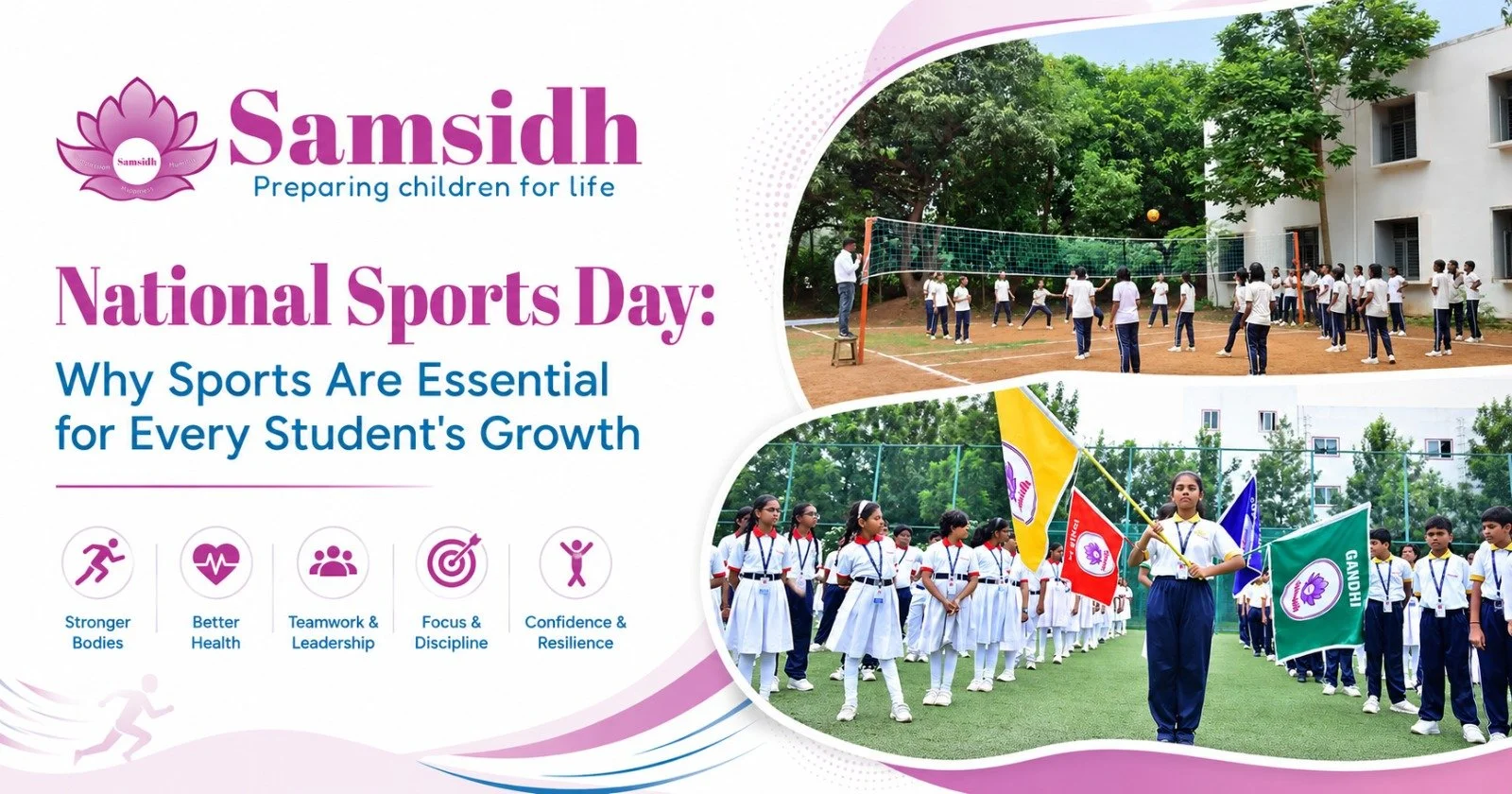
National Sports Day is observed in India on 29 August every year to honour the birth anniversary of hockey legend Major Dhyan Chand. It celebrates the role of sports in national life and, for students, is a powerful reminder that sports are essential for growth — building physical fitness, discipline, teamwork, focus and leadership that classroom learning alone cannot deliver.
Every year on 29 August, schools across India mark National Sports Day with matches, races and felicitations. But for parents choosing a school, the day raises a bigger question: how much do sports really matter for my child’s future? The short answer is — a great deal. Decades of evidence show that children who play sports grow up healthier, more confident and often perform better academically. This guide explains what National Sports Day is, the legacy of Major Dhyan Chand, and exactly why and how sports shape a student’s growth — with grade-wise ideas, facts and FAQs for parents.
What is National Sports Day?
National Sports Day is an annual observance held in India on 29 August to promote the importance of sports and physical fitness in everyday life. India first celebrated it in 2012, and the date is fixed because it marks the birthday of Major Dhyan Chand (1905–1979), widely regarded as one of the greatest field hockey players in history.
The day is organised under the Ministry of Youth Affairs and Sports and observed in schools, colleges and sports academies nationwide. On this day, the President of India confers the National Sports Awards at Rashtrapati Bhavan — including the Major Dhyan Chand Khel Ratna Award (India’s highest sporting honour), the Arjuna Award for athletes and the Dronacharya Award for coaches.
Who was Major Dhyan Chand?
Major Dhyan Chand was an Indian field hockey player, born on 29 August 1905 in Allahabad (now Prayagraj), Uttar Pradesh. Famous for his extraordinary ball control, he earned the nickname “The Wizard” (or “Wizard of Hockey”).
His achievements are staggering: he led India to three consecutive Olympic gold medals — Amsterdam 1928, Los Angeles 1932 and Berlin 1936 — during the golden era of Indian hockey. His skill made him a lasting symbol of sporting excellence, and the Dhyan Chand National Stadium in New Delhi is named in his honour. In 2021, India renamed its highest sporting award the Major Dhyan Chand Khel Ratna in his memory. His story — that greatness comes from discipline and relentless practice, not just talent — is exactly the lesson National Sports Day passes to students.
Why are sports essential for a student's growth?
Sports are not a break from education — they are part of it. Physical activity develops the body, sharpens the mind and builds character at the same time. This is why sports sit at the heart of the role of sports in the holistic development of children.
The table below maps each major benefit to how sport actually builds it:
| Benefit for the student | How sports build it |
|---|---|
| Physical fitness & health | Regular play improves stamina, strength, immunity and healthy weight; reduces screen time |
| Discipline & time management | Practice schedules, rules and routines teach consistency and punctuality |
| Teamwork & communication | Team games require cooperation, trust and clear communication toward a shared goal |
| Leadership & decision-making | Captaincy and quick on-field choices build confidence and judgement under pressure |
| Focus & academic performance | Exercise boosts blood flow to the brain, improving concentration and memory |
| Resilience & emotional strength | Winning and losing teach students to handle success and setbacks with maturity |
| Social skills & sportsmanship | Fair play, respect for opponents and empathy carry into everyday life |
Takeaway: sports develop the whole child — head, heart and body — in ways textbooks cannot.
Sports vs. academics: why it's not a trade-off
A common worry among parents is that sports steal time from studies. The evidence points the other way. Physically active students tend to show better concentration, memory and classroom engagement — meaning sport often supports academic results rather than competing with them. The healthiest approach treats the two as partners, which is why sports education is as important as academics in a well-designed school. A child who moves, plays and competes learns to focus, manage time and bounce back — habits that show up directly in the classroom.
How schools celebrate National Sports Day
Most Indian schools mark 29 August with a mix of ceremony, competition and awareness:
- March-past and fitness pledge to open the day.
- Track and field events — sprints, relays, long jump, high jump.
- Inter-house team matches — football, basketball, volleyball, kho-kho, kabaddi.
- Felicitation of student athletes and a tribute to Major Dhyan Chand.
- Fun, inclusive games so every child participates, not only star athletes.
- Talks or quizzes on Dhyan Chand, the Olympics and Indian sporting heroes.
These events sit within a school’s wider commitment to extracurricular activities in CBSE schools that balance academics with hobbies and physical activity.
National Sports Day activity ideas
Match the activity to the child’s stage so every student takes part meaningfully:
| Stage | Best-fit activities | Skill focus |
|---|---|---|
| Pre-primary (Nursery–KG) | Fun races, balloon games, simple obstacle course | Motor skills, participation |
| Primary (I–V) | Sack race, relay, tug of war, mini field events | Coordination, team spirit |
| Middle (VI–VIII) | Inter-house team matches, athletics, sports quiz | Teamwork, strategy |
| Secondary (IX–XII) | Competitive tournaments, event management, refereeing | Leadership, responsibility |
How parents can encourage a lifelong sporting habit
Sports habits start at home as much as at school. A few practical steps:
- Make it daily, not occasional — an hour of active play beats an intense weekend-only routine.
- Let the child choose the sport — enjoyment sustains the habit.
- Praise effort, not just winning — this builds resilience and keeps them playing.
- Limit screen time and offer active alternatives.
- Partner with the school on coaching and practice.
For a deeper playbook, see our guide on how to encourage children in sports and physical education.
Government initiatives promoting sports in India
National Sports Day also spotlights India’s push to build a stronger sporting culture — useful context for parents:
- Fit India Movement — launched on National Sports Day, 29 August 2019, to make fitness part of daily life, with a strong schools component.
- Khelo India — identifies and nurtures grassroots sporting talent through the Khelo India Youth Games and school-level competitions.
- National Sports Awards — conferred on 29 August, recognising athletes and coaches and inspiring young players.
These initiatives reinforce a simple message: sport is a national priority, and school is where the habit begins.
How to choose a CBSE school with strong sports (a parent's checklist)
For parents, National Sports Day is a good lens for evaluating schools. A school that celebrates it meaningfully usually invests in sport year-round. Look for:
- Proper facilities — playgrounds, courts, a track and age-appropriate equipment.
- Trained PE staff and coaches, not just a token period.
- A real sports calendar — inter-house and inter-school competitions, not one annual event.
- Inclusive participation — every child plays, regardless of skill level.
- A sports-academics balance backed by consistent academic excellence, so children thrive in both.
Samsidh Group of Schools treats sport as core to raising confident, healthy 21st-century learners, with CBSE campuses across Bangalore, Andhra Pradesh, Tamil Nadu and Haryana that pair strong academics with physical education and holistic development.
Admissions Open for 2027-28
Looking for a CBSE school where sports and academics grow together? Find your nearest Samsidh campus and see how we build fit, confident learners. Book a campus visit / Enquire about admissions → · Toll-free 1800 274 9998 · contact@samsidh.in
Frequently asked questions
1. Why is National Sports Day celebrated on 29 August?
It marks the birth anniversary of Major Dhyan Chand, India’s legendary hockey player, born on 29 August 1905. India has observed National Sports Day on this date since 2012.
2. Who was Major Dhyan Chand?
A field hockey legend nicknamed “The Wizard,” he led India to three consecutive Olympic gold medals in 1928, 1932 and 1936, and is regarded as one of the greatest hockey players ever.
3. Why are sports important for students?
Sports build physical fitness, discipline, teamwork, focus, resilience and leadership, and can improve academic performance — supporting a child’s overall growth.
4. Do sports affect academic performance?
Positively. Physical activity improves concentration, memory and classroom engagement, so students who play sports often perform better academically.
5. How do schools celebrate National Sports Day?
With a march-past and fitness pledge, track and field events, inter-house matches, felicitation of student athletes and a tribute to Major Dhyan Chand.
6. What are good National Sports Day activities for school students?
Sprints, relays, long jump, tug of war and fun races for younger children; competitive tournaments, athletics and event management for older students.
7. What is the Fit India Movement?
A national campaign launched on National Sports Day, 29 August 2019, to encourage everyday fitness, with a strong focus on schools and students.
8. How do I choose a CBSE school with good sports?
Look for proper facilities, trained coaches, a full sports calendar, inclusive participation and a genuine balance between sports and academics.
Key takeaways
- National Sports Day is 29 August, honouring Major Dhyan Chand (three Olympic golds; observed since 2012).
- Sports are essential, not optional — they build fitness, discipline, teamwork, focus and leadership.
- Sports and academics reinforce each other; active students often learn better.
- Initiatives like Fit India and Khelo India make sport a national priority that starts at school.
- How a school runs sport is a strong signal of its commitment to holistic development.
Conclusion
National Sports Day is more than a date on the calendar — it’s a reminder that a healthy, active childhood is the foundation of a successful adult life. Major Dhyan Chand’s legacy teaches that discipline and effort, not talent alone, create champions. For parents, the takeaway is clear: choose a school where sports are woven into everyday learning, and give your child the fitness, confidence and character that last a lifetime.
Want that for your child? Enquire about admissions to Samsidh Group of Schools for 2027-28, or call toll-free 1800 274 9998 to book a campus visit.